
When I speak with SME owners about AI, I usually hear one of two things.
The first is curiosity: We know AI matters, but we’re not sure where to begin.
The second is frustration: We’ve looked at the tools, but it all feels bigger, noisier and more technical than it should.
That reaction is completely normal.
Most SMEs do not have spare time, spare budget, or a specialist AI team ready to lead a major transformation program. They are focused on serving customers, supporting their staff, and keeping the business moving.
That is exactly why I believe AI transformation for SMEs must be practical.
In my experience, the businesses that do this well do not start with hype. They start with a real business problem. They look at where work gets stuck, where time is lost, or where quality slips. Then they ask whether AI can improve that in a way they can measure.
That is the approach I recommend, and it is the one I’ve set out in this guide.
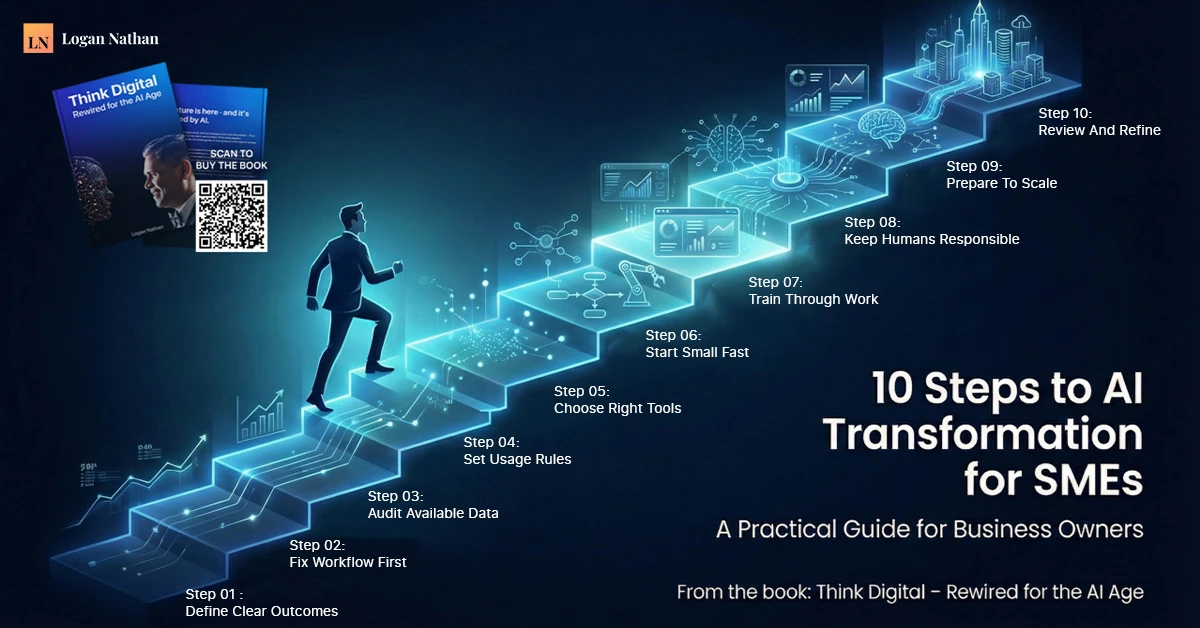
1. Get clear on what you want to improve
Before you look at platforms, prompts, or automations, get clear on the result you want.
I always tell business owners that AI is not the strategy. It is a tool that should support the strategy. If you do not know what you want to improve, it is very easy to get distracted by features that look impressive but do little for the business.
So I start with simple questions.
- Where is the business losing time?
- Where are staff doing too much repetitive work?
- Where are customers waiting too long?
- Where are mistakes or uneven results showing up?
Once you’ve identified those friction points, define one or two outcomes that matter. That might be faster response times, fewer quoting mistakes, quicker admin turnaround, or more consistent customer communication.
The simpler and more measurable the goal, the better.
2. Look at the work before you add the technology
One of the most useful things an SME can do is map a process from start to finish.
I’ve seen plenty of cases where a business thinks it needs AI, but what it really needs first is a cleaner workflow. If the process is full of unnecessary handovers, repeated effort, and poor inputs, AI will not fix that on its own.
That is why I recommend choosing one workflow and breaking it down.
Look at what happens first, what happens next, who is involved, what systems are used, and where delays or rework tend to happen.
You are trying to spot the tasks that are repetitive, predictable, and time-consuming. Those are often the areas where AI can create early value.
It could be triaging enquiries, summarising meetings, extracting information from forms, classifying emails, or drafting a first version of routine content.
But first, understand the process. Then improve it. Then decide where AI fits.
3. Work out what data you actually have
A lot of AI conversations skip over this step, but I think it is one of the most important.
For AI to be useful in a business setting, it needs access to reliable information. That does not mean your data has to be perfect. Most SMEs do not have perfect data. But it does mean you need a clear view of what information exists, where it lives, and how much you can trust it.
I usually suggest a simple data check across the systems that matter most — your CRM, inboxes, spreadsheets, accounting software, shared folders, and any operational platforms your team uses every day.
You are looking for a few basic things.
- What information do we rely on?
- Who owns it?
- How current is it?
- How messy is it?
- And what should never be entered into an AI tool without approval?
That last point matters. Good AI adoption is not just about productivity. It is also about trust, privacy, and control.
4. Set basic rules before your team starts testing tools
One thing I’ve learnt is that if you give a team access to AI without guidance, everyone will use it differently.
Some people will be cautious. Some will avoid it altogether. Others will jump in straight away and start pasting in whatever they are working on. That can create risk.
So before you go too far, put a few ground rules in place.
They do not need to be formal or complicated. In fact, simple is better. But people should know which tools are approved, what jobs those tools can be used for, what information is off-limits, and when a human review is required.
These rules help the team move with confidence. They reduce hesitation, and they reduce careless mistakes.
For SMEs, practical governance almost always works better than heavy governance.
5. Choose tools that fit your business, not someone else’s
I see this mistake often: a business chooses an AI platform because it sounds advanced, or because a larger company is using something similar.
That is rarely the right reason.
The best AI system for an SME is usually the one that fits neatly into the way the business already works. It should be easy to test, easy to manage, and useful without a major technical lift.
In many cases, the smartest place to start is with AI built into software you already use. Sometimes that is enough to create real value. In other cases, a more specialised tool is worth piloting.
What matters most is fit.
- Does it connect with your existing systems?
- Can you control access?
- Is the team likely to use it properly?
- Can you measure whether it is helping?
I would always rather see an SME choose a straightforward, well-integrated option that gets used than a more powerful tool that sits on the shelf.
6. Start small enough to learn quickly
This is one of the main ideas I come back to with SMEs: keep the first move small.
AI transformation is not about launching ten initiatives at once. It is about building confidence and proving value in a controlled way.
That is why I encourage businesses to begin with one or two use cases only. Ideally, those use cases should be practical, visible, and easy to assess.
Good early examples include drafting replies to common customer questions, turning meeting notes into action lists, extracting information from invoices or forms, or summarising internal documents so staff can move faster.
What I am looking for in a first use case is not complexity. I am looking for usefulness.
If the team can see time being saved, quality improving, or frustration dropping, that creates momentum for the next stage.
7. Train your people in the flow of work
A lot of business owners worry that their staff are too busy to build AI capability. I understand that concern, but I think the real issue is often how the training is delivered.
When learning is too abstract, too long, or too far removed from daily work, it does not stick.
What works better, in my experience, is small and regular practice tied directly to real tasks. Show the team how to use AI for something they already do. Let them test it. Compare the result. Improve the approach. Repeat.
That rhythm builds confidence much faster than a long workshop followed by no real use.
I also encourage SMEs to identify internal adopters — people who are curious, willing to test, and able to help others. They do not need a new title or a separate role. They just need enough ownership to help the business build shared capability.
Over time, that internal confidence becomes one of your strongest assets.
8. Make sure people stay responsible for the output
I’m optimistic about AI, but I’m not casual about quality.
AI can save time, but it can also produce poor judgement, incorrect statements, or content that sounds fine on the surface while missing important context. That is why I always recommend human oversight, especially in higher-risk situations.
For internal admin, the review process may be light. For anything customer-facing, financial, legal, or brand-sensitive, the review should be more deliberate.
The key is deciding in advance where AI can assist, where it can draft, and where it must not act on its own.
I like to make that clear. It removes uncertainty for the team and makes adoption safer.
This also reinforces an important mindset: AI can support good work, but it should not replace responsibility.
9. Build the foundations for scale, even if you are only piloting
Even when an SME is testing just one use case, I encourage them to think one step ahead.
- If this works, where will the prompts live?
- Where will outputs be stored?
- How will the team reuse what they have learnt?
- How will access be managed as more people get involved?
These may sound like small operational details, but they matter. Without them, useful knowledge gets trapped in individual habits instead of becoming part of the business.
The businesses that scale AI well are the ones that start treating it as part of an operating model, not just a set of one-off experiments.
That means creating shared assets like templates, prompts, review checklists, approved workflows, and storage rules, so adoption becomes repeatable and not dependent on one person.
10. Review what’s working and keep adjusting
AI transformation is not something you “finish”.
It is a capability the business builds over time.
Some experiments will work straight away. Others will not. Some will save more time than expected. Others will create more friction than value. That is normal.
What matters is whether you learn from each step.
I recommend reviewing AI initiatives regularly. Look at the original goal, the actual impact, the team’s feedback, and any issues that came up. Decide what to improve, what to pause, and what is ready to expand.
This keeps AI tied to business performance rather than novelty.
For SMEs, that matters enormously. You do not need to chase every new tool or trend. You need a practical way to adopt what genuinely helps.
Where my book fits into this conversation
I wrote “Think Digital – Rewired for the AI Age” to help business owners approach digital and AI change with more clarity and less noise.
It is not meant to be a deep technical manual. It is designed to help leaders think clearly about where digital capability fits into the business, how decisions should be made, and what kind of leadership is needed to make change stick.
For SME owners, structure is incredibly valuable. When everything in the market feels urgent, structure helps you focus. It helps you make better decisions about priorities, pace, people, and systems.
That is how I see the book being most useful, not as a shortcut, but as a guide for making smarter decisions as you build your roadmap.
A realistic way to begin over the next 30 days
If I were advising an SME owner to get moving this month, I would not start with a massive implementation plan.
I would suggest something much simpler.
- In the first week, choose one business outcome and one workflow worth examining.
- In the second week, test one tool with a small group of users.
- In the third week, improve the prompts, tighten the review process, and measure the impact.
- In the fourth week, document what worked and share the learning more broadly across the team.
That kind of progress is realistic. It creates evidence. And it gives the business a much stronger base for deciding what to do next.
Final thoughts
The SMEs that will benefit most from AI are not always the ones with the biggest budgets or the most advanced technology stack.
They are the ones that stay focused, move with purpose, involve their people, and keep connecting AI back to real business outcomes.
That is the mindset I encourage.
Start with the work. Start with the friction. Start with the chance to improve something that matters.
Then build from there.