
Share this article

Table of Contents

How Can I Use AI in My Small Business? An Essential Guide for SMEs

How Can I Use AI in My Small Business? An Essential Guide for SMEs

Table of Contents

Key Takeaways

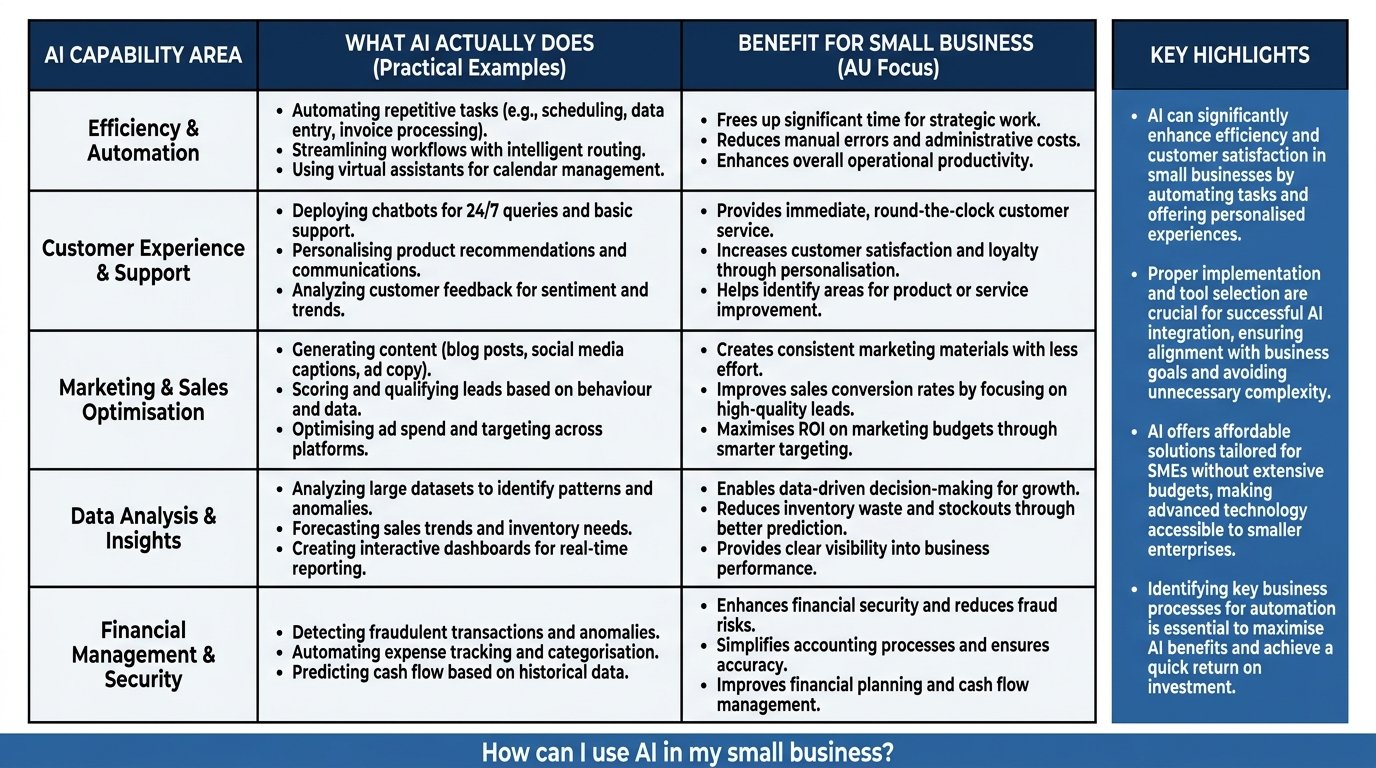
  • AI can significantly enhance efficiency and customer satisfaction in small businesses.
  • Proper implementation and tool selection are crucial for successful AI integration.
  • AI offers affordable solutions tailored for SMEs without extensive budgets.
  • Identifying key business processes for automation is essential to maximise AI benefits.

Key Answer

Unlock AI’s potential in your small business to streamline operations, enhance customer service, and gain competitive insights without heavy investments. Learn practical steps to implement AI effectively.

The question ‘How can I use AI in my small business?’ has become increasingly relevant as businesses of all sizes recognise the potential of AI to revolutionise their operations. While AI might seem daunting at first, its applications can be surprisingly accessible and effective, especially for SMEs eager to gain a competitive edge without incurring massive costs.

Through personal experience and extensive research, I’ve found that AI can address many of the challenges faced by small businesses. From automating routine tasks to enhancing customer engagement, AI has the potential to optimise various facets of business operations. Let’s delve into how AI can make a tangible difference in your small business.

What Can AI Actually Do for a Small Business?

AI can transform small businesses by automating mundane tasks, providing insights from data, and enhancing customer interactions. Contrary to popular belief, you don’t need a huge budget to benefit from AI. There are countless affordable tools that cater specifically to SMEs, helping them tackle routine operations and improve efficiency.

For instance, AI can automate data entry, manage customer interactions through chatbots, and provide predictive insights for better decision-making. These applications not only save time but also enhance accuracy and customer satisfaction. However, it’s crucial to understand that AI is not a one-size-fits-all solution. Its effectiveness largely depends on identifying specific areas of your business that can benefit from AI interventions.

Where Should I Start Using AI in My Business?

Start by identifying areas where manual processes are frequent, such as data entry, scheduling, and customer enquiries. AI excels in handling repetitive tasks, freeing your team to focus on strategic initiatives. Look for bottlenecks where customer satisfaction suffers due to slow service or manual errors.

Conducting an operational audit can highlight these pain points. I recommend looking at your business processes and asking: Which tasks are time-consuming and prone to errors? Where are resources being underutilised? Pinpoint these areas to maximise the impact of AI deployment.

Expert Perspective

SME AI Integration Specialist

In my years of working with small businesses, I’ve seen AI act as a catalyst for growth and innovation. The key lies in strategic integration and selecting the right tools that align with business goals. AI should complement human efforts, not replace them.

How Can AI Save Time and Reduce Administrative Work?

AI significantly cuts down administrative workloads by automating emails, generating meeting notes, and managing schedules. Tools like scheduling assistants and virtual secretaries streamline communication and organisation, letting you reclaim hours otherwise spent on these tasks.

Imagine a scenario where your AI system automatically sorts emails, books meetings, and even drafts responses. This not only enhances productivity but also reduces human error, allowing your team to focus on more creative and impactful work.

How Can AI Improve Sales, Marketing, and Customer Service?

AI-powered tools can enhance your sales and marketing efforts by personalising customer interactions and automating lead nurturing. AI helps you understand customer preferences through data analytics, allowing for tailored marketing campaigns and improved customer service.

For example, AI can analyse customer data to suggest personalised product recommendations, manage customer enquiries via chatbots, and even automate follow-ups. These capabilities ensure that your marketing efforts are not only more efficient but also more effective, leading to increased customer satisfaction and loyalty.

Which Business Processes Should I Automate with AI -- and Which Should I Not?

Automation is transformative, but it’s essential to choose the right processes. Automate tasks that are repetitive and structured, such as data entry and customer inquiries. Avoid automating tasks that require critical thinking or personal engagement, as these are better handled by humans.

A pitfall to avoid is automating a flawed process, which could lead to faster yet inaccurate results. Focus on improving the process first, then apply AI for efficiency. This approach ensures that AI implementation truly adds value to your operations.

What AI Tools Should a Small Business Consider?

When selecting AI tools, consider categories such as generative AI for content creation, CRM AI for managing customer relationships, and workflow automation tools for operational efficiency. Tools like CRM systems can enhance customer service, while accounting software streamlines financial operations.

It’s important to choose tools that align with your business needs. An AI tool that works wonders for one business might not be suitable for another. Conducting a needs assessment and using resources like an AI Decision Matrix can aid in selecting the best tools for your business.

What Are the Risks of Using AI in a Small Business?

While AI offers numerous benefits, it also comes with risks such as privacy concerns, data security, and the potential for inaccurate outputs. It’s vital to establish governance frameworks and ethical guidelines to manage these risks effectively.

Consider the implications of AI on data privacy and the accuracy of AI-generated content. Ensuring compliance with regulations, such as GDPR, and implementing strong cybersecurity measures can mitigate risks. Moreover, maintaining human oversight ensures that AI complements rather than replaces human judgement.

How Do I Build a Practical AI Action Plan for My Business?

Start by identifying a key problem in your business that AI can solve. Prioritise tasks based on their impact and feasibility. Pilot AI solutions on a small scale to measure outcomes and refine processes before scaling up.

Follow a structured roadmap: Identify → Prioritise → Pilot → Measure → Improve → Scale. This phased approach helps manage risks and ensures a more seamless integration of AI technologies into your business operations. By focusing on specific problems rather than attempting to overhaul your business overnight, you can realise the true potential of AI.

Frequently Asked Questions

Small businesses should consider tools like CRM AI, marketing automation, and analytics software to enhance efficiency and customer engagement.

Not necessarily. Many AI tools are affordable and tailored for small businesses, providing cost-effective solutions without the need for a large technology budget.

AI can automate customer inquiries through chatbots, provide personalised communication, and analyse customer feedback to improve service offerings.

Avoid automating tasks that require personal interaction, creativity, or critical thinking, as these are best suited for human handling.

Begin by identifying key areas where AI can add value, then implement a phased approach to integrate AI tools, starting with a pilot project to measure impact.

0