
Share this article

Table of Contents

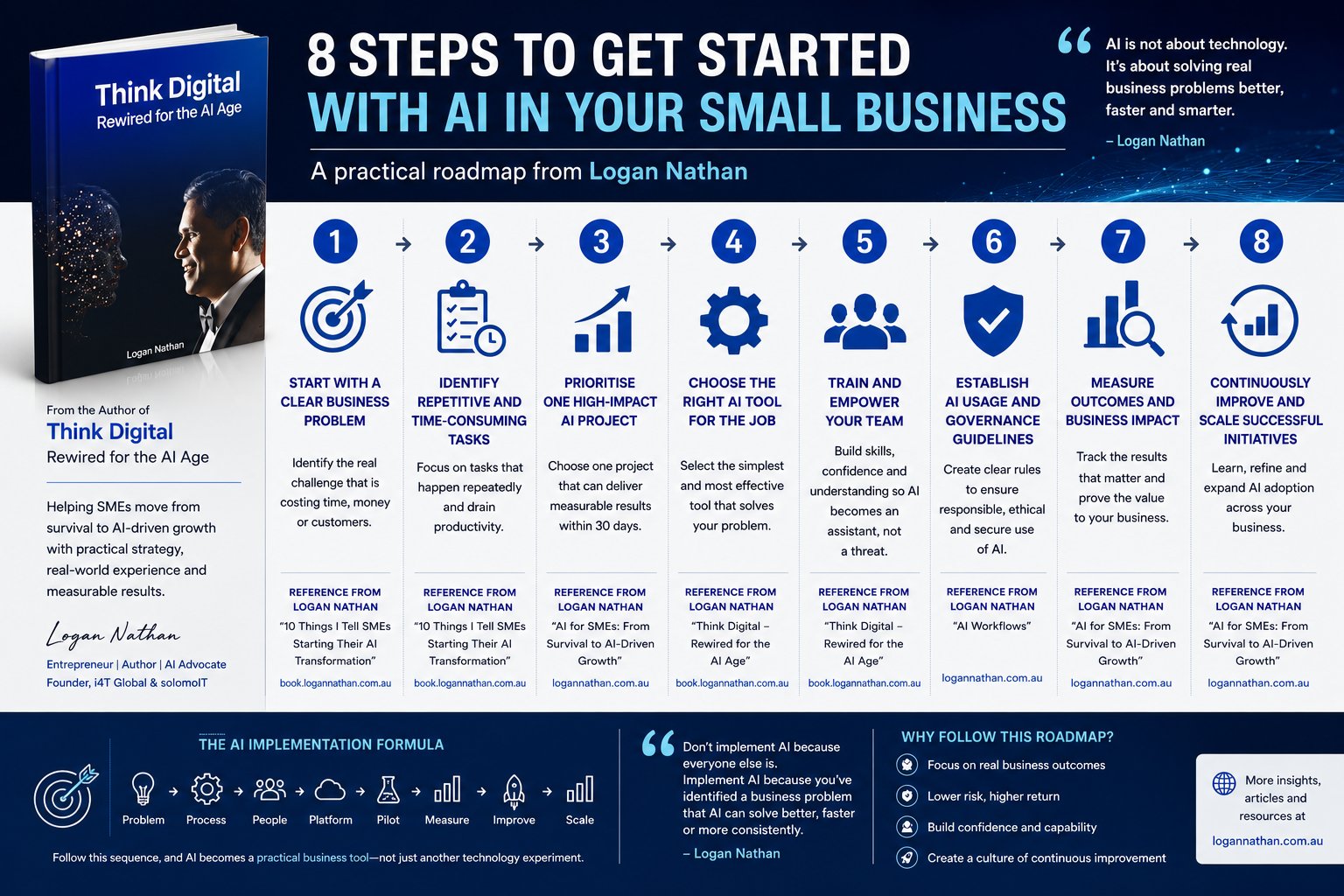
8 Steps to Get Started with AI in Your Small Business

8 Steps to Get Started with AI in Your Small Business

Table of Contents

Key Takeaways

  • Identify specific business problems to address with AI.
  • Focus on automating repetitive, time-consuming tasks.
  • Select high-impact AI projects that promise measurable outcomes.
  • Choose AI tools that align with your business needs and infrastructure.

Key Answer

Discover the 8 essential steps to integrate AI into your small business effectively. From identifying key tasks to implementing AI tools and training your team, this guide provides a comprehensive roadmap for AI success.

In the fast-paced world of business, small enterprises often grapple with limited resources while aiming for maximum impact. Embracing AI technology is no longer a futuristic idea but a necessary step to stay competitive. Here, I will take you through 8 crucial steps to get started with AI in your small business.

1. Start with a Clear Business Problem

Every successful AI journey begins with identifying a tangible business problem. For small businesses, this might be the bottleneck in customer service or inefficiencies in inventory management. By pinpointing these issues, you lay a strong foundation for AI application.

In my experience, businesses that clearly outline their pain points are better poised to harness AI’s potential. Whether it’s reducing customer wait times or improving product delivery, defining these areas is crucial.

2. Identify Repetitive and Time-Consuming Tasks

Once you’ve outlined your primary business problems, the next step is to identify tasks within your operations that are both repetitive and time-consuming. Common examples include data entry, scheduling, and customer support queries.

Automating these tasks not only streamlines operations but also frees up valuable time for your team to focus on strategic initiatives. For instance, I’ve observed that automating data entry can reduce errors and significantly speed up processes.

Expert Perspective

AI Implementation Specialist

As SMEs continue to navigate the complexities of modern business, embracing AI technology is not just an option but a necessity for sustainable growth. The steps outlined in this guide provide a practical roadmap that aligns AI integration with business needs, ensuring that the adoption process is not only feasible but also effective. SMEs that take a measured, step-by-step approach to AI adoption will find themselves better positioned to compete and thrive in the digital age. AI, when implemented correctly, can serve as a powerful catalyst for innovation and efficiency, transforming the way businesses operate and engage with customers.

3. Prioritise One High-Impact AI Project

After identifying these tasks, it’s important to prioritise one high-impact AI project. Focus on a project that not only addresses a significant pain point but also promises measurable outcomes.

For instance, if order processing delays impact customer satisfaction, then streamlining this process with AI should be your priority. This focused approach ensures resource optimisation and sets a precedent for future AI projects.

4. Choose the Right AI Tool for the Job

Selecting the appropriate AI tool is critical. The tool should align with your business needs and existing infrastructure. Whether it’s a chatbot for customer service or an analytics platform for data insights, the tool must integrate seamlessly into your operations.

With a plethora of options available, it’s crucial to evaluate tools based on their scalability, ease of use, and compatibility. I’ve found that tools like Zapier or IBM Watson offer robust solutions for various SME needs.

5. Train and Empower Your Team

AI tools are only as effective as the team that uses them. Thus, training your staff is a non-negotiable step. Equip them with the necessary skills to operate and maintain the AI systems.

Hands-on workshops and tutorials can significantly boost your team’s confidence and competence in using AI tools effectively. Incorporating AI prompts can also facilitate learning and adoption.

6. Establish AI Usage and Governance Guidelines

Setting clear guidelines for AI use within your business ensures accountability and clarity. Define what AI should and shouldn’t do, who oversees its operation, and when human oversight is required.

Creating these guidelines helps in mitigating risks and ensuring that the AI tools are used responsibly. It’s vital to position AI as a support mechanism rather than a replacement for human roles.

7. Measure Outcomes and Business Impact

It’s imperative to measure the outcomes of your AI initiatives to understand their effectiveness. Establish key performance indicators (KPIs) that reflect the objectives you’ve set out to achieve.

These metrics could include reduced processing times, enhanced customer satisfaction, or increased revenue. By measuring these outcomes, you can determine the return on your AI investment and adjust strategies as necessary.

8. Continuously Improve and Scale Successful Initiatives

AI adoption is an ongoing process. As your business grows and evolves, so should your AI strategies. Continuously refine and scale successful initiatives to ensure sustained growth.

Incorporate feedback from your team and customers to enhance AI functionalities. By keeping abreast of technological advancements and market trends, you can maintain a competitive edge in the AI landscape.

Don’t forget to explore more comprehensive strategies in Boost SME Growth with AI.

Case Study: Real-World AI Implementation in SMEs

“AI adoption should follow business maturity, structured workflows and measured implementation–not hype.”

Consider a small Australian retail business that faced challenges with inventory management. They started with a simple AI tool to track stock levels and predict demand trends. The impact was significant, reducing stockouts by 30% and improving cash flow.

  • Challenge: Inefficient inventory management leading to frequent stockouts.
  • Solution: Implementation of an AI-driven inventory tracking system.
  • Results: 30% reduction in stockouts, enhanced cash flow, and improved customer satisfaction.

This is just one example of how an AI implementation roadmap, like the one in AI for SMEs: From Survival to AI-Driven Growth, can transform small business operations.

Frequently Asked Questions

Evaluate AI tools based on their compatibility with your current systems, scalability, and specific business needs. It’s important that the tool aligns well with your operations.

Training ensures that your team is well-equipped to effectively use AI tools, maximising the return on your investment and empowering your staff.

Common mistakes include not clearly defining business problems, choosing tools based on hype rather than needs, and failing to measure outcomes effectively.

AI can automate repetitive tasks, enhance decision-making, improve customer interactions, and provide valuable insights that drive strategic growth.

Sources & Further Reading

0