
AI is moving quickly, and it is easy to feel like every business needs to jump in immediately.
New tools appear every week. Competitors are experimenting. Teams are asking what they should use. Business owners are wondering whether they are falling behind. The pressure is real.
But here is the part many SMEs need to hear before they buy another subscription, install another platform, or ask their team to “start using AI.”
AI will not solve a business problem that the business has not properly understood.
It can speed up a process. It can help organise information. It can draft, summarise, analyse, automate, recommend, and respond. But it cannot magically create business clarity where none exists.
If a business has not listened to its customers, its team, its data, and the market, AI may simply make the confusion faster.
And that is the risk.
AI Is Not the Starting Point
Many business owners begin their AI journey with the same question:
“What AI tool should we use?”
It is a natural question, but it is rarely the best first question.
A better starting point is:
“What problem are we actually trying to solve?”
That small shift matters.
Because AI is not valuable just because it is advanced. It becomes valuable when it is applied to a real business problem. A slow response time. A broken handover. A repetitive admin task. A confusing customer journey. A sales process that keeps leaking opportunities. A reporting process that takes hours but still does not create useful insight.
Without that clarity, a business can easily end up using AI for the sake of using AI.
That may look innovative from the outside, but inside the business, it often creates more noise than progress.
The Businesses That Listen Will Move Faster
For a long time, many businesses operated by talking at the market.
They promoted their services. They explained their differences. They posted updates. They sent campaigns. They told customers why they were the right choice.
Some of that still matters. But in the AI age, the businesses that gain the strongest advantage will not be the ones making the most noise.
They will be the ones paying the closest attention.
They will notice what customers ask before they buy. They will understand where people hesitate. They will spot which questions keep coming up. They will take complaints seriously. They will look at lost leads, delayed quotes, unclear service steps, repeated support issues, and internal bottlenecks as signals.
Every point of friction is information.
And in many SMEs, those signals already exist. They are sitting inside emails, enquiry forms, sales calls, reviews, support tickets, CRM notes, team conversations, and spreadsheets.
The problem is not always that the business lacks information.
Often, the business simply has not slowed down enough to hear what the information is saying.
Customer Friction Is Often Where AI Should Begin
AI opportunities are usually not hiding in big strategy documents.
They are often hiding in the everyday frustrations of the business.
If customers keep asking the same questions before making a purchase, that may point to unclear website content, weak onboarding, poor product explanations, or a missing FAQ structure.
If proposals take too long to prepare, that may point to scattered information, manual formatting, inconsistent pricing logic, or too much dependence on one person.
If leads keep going cold, that may suggest slow follow-up, unclear next steps, weak nurturing, or poor visibility across the sales pipeline.
If the team spends hours copying information between systems, that may show a process problem that AI or automation could reduce.
But the important point is this:
The AI opportunity does not begin with the tool.
It begins with the pattern.
Once a business sees the pattern, the technology decision becomes much easier. Instead of asking, “What can this AI tool do?” the business can ask, “Can this help us solve the problem we now understand?”
That is a much stronger position to be in.
Automating the Wrong Thing Is Still the Wrong Thing
One of the biggest mistakes SMEs can make is using AI to automate a process that should have been questioned first.
For example, a business might say, “We want to use AI for customer service.”
That sounds reasonable. But what does it actually mean?
Are customers waiting too long for replies? Are team members giving inconsistent answers? Are people asking basic questions because the website is unclear? Are complaints increasing because expectations are not being managed properly? Are support requests coming from a product issue, a communication issue, or a delivery issue?
Those are not the same problems.
Each one would require a different response.
AI may be useful in all of them, but only if the business understands which problem it is solving.
Otherwise, AI may help the business reply faster without improving the customer experience. It may generate more content without building more trust. It may summarise data without helping leaders make better decisions. It may automate a workflow that should have been redesigned instead.
Speed is only useful when the direction is right.
Listening Is a Business Discipline
Listening can sound soft, but in a modern business, it is strategic.
It helps leaders decide where to invest. It helps teams understand what matters. It helps owners avoid wasting money on technology that looks impressive but does not change outcomes.
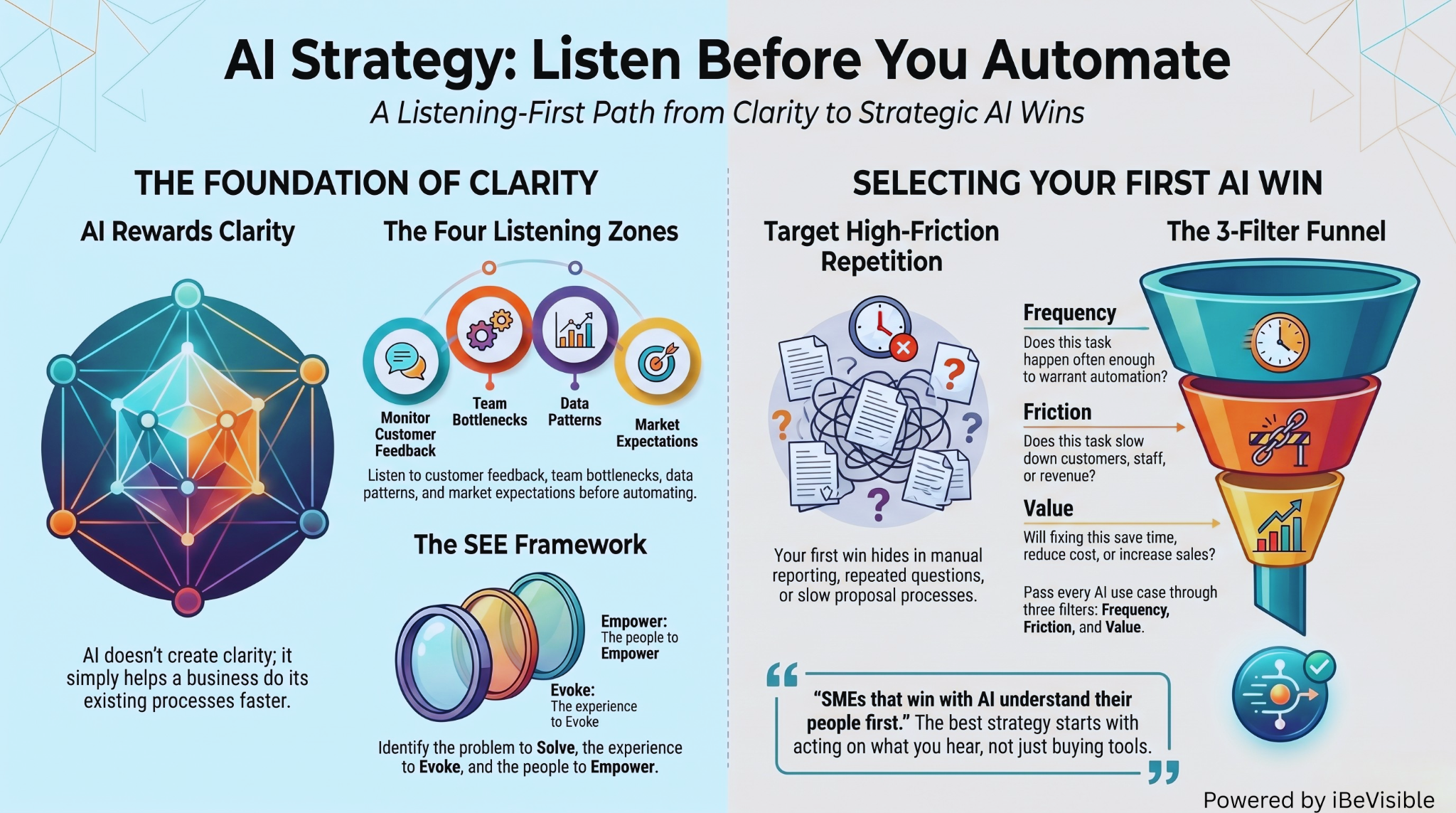
A listening business pays attention to four key areas.
1. Listen to Customers
Customers often reveal the next improvement a business needs to make.
They do it through their questions, objections, delays, feedback, complaints, praise, confusion, and silence.
A customer who asks the same question three times is showing you where your communication is unclear. A customer who drops off after receiving a quote may be showing you where your value is not being explained properly. A customer who praises a specific part of your service may be showing you what should be strengthened and repeated.
AI can help organise and analyse this feedback, but the business must first care enough to collect it and act on it.
2. Listen to Your Team
Your team usually knows where time is being wasted.
They know which tasks are repeated every week. They know which systems are clunky. They know where customers get frustrated. They know where information gets lost. They know which processes only work because one person keeps everything together manually.
Before introducing AI, ask the team what slows them down.
You may find that the best first AI use case is not glamorous. It might be helping staff draft routine replies, summarise meeting notes, search internal knowledge, prepare proposals, update records, or reduce manual reporting.
That may not sound dramatic, but for a busy SME, it can be incredibly valuable.
3. Listen to the Data
Data is not just something to put in a monthly report.
It is a way of seeing what is really happening.
Which pages on your website convert? Which emails get replies? Which campaigns attract the wrong leads? Which services are profitable? Which customers return? Which issues keep repeating? Where does the sales process slow down?
AI can help make sense of data, especially when it is messy or spread across different places. But again, the goal is not more data for the sake of it.
The goal is better decisions.
4. Listen to the Market
Customer expectations are changing quickly.
People expect clearer communication, faster responses, smoother digital experiences, and more personalised service. That does not mean every SME has to behave like a large tech company. But it does mean businesses cannot ignore the standard customers are now used to.
AI can help smaller businesses meet those expectations without needing huge teams.
But only if the business understands what customers now value.
A Simple Framework: Listen Before You Automate
Before choosing an AI tool, SMEs should pause and work through three practical questions.
What problem needs to be solved?
Be specific.
Not “we need AI for sales.”
Instead:
“We need to follow up with new leads within one hour.”
Not “we need AI for admin.”
Instead:
“We need to reduce the time spent preparing weekly reports.”
Not “we need AI for customer service.”
Instead:
“We need customers to get accurate answers to common questions without waiting for a team member.”
Specific problems create better AI decisions.
What should the experience feel like?
AI should not make the business feel colder or harder to deal with.
Used well, it should remove friction and create a better experience for customers and staff.
A customer should feel informed, supported, and clear about what happens next. A team member should feel less buried in repetitive work. A manager should feel more confident about the information they are using to make decisions.
The experience matters because people remember how a business made them feel.
AI should improve that feeling, not damage it.
Who needs to be empowered?
The purpose of AI is not to impress people with technology.
It is to help people take better action.
That might mean helping customers get answers faster. It might mean helping staff complete work with less friction. It might mean helping leaders see patterns they would otherwise miss. It might mean helping sales teams personalise follow-up or helping operations teams reduce errors.
The best AI use cases are not just efficient.
They are useful.
Start With One Repeated Problem
For most SMEs, the best first AI project is not a massive transformation program.
It is a repeated problem that is worth solving.
Look for something that happens often, takes time, causes frustration, affects customers, or creates measurable cost.
That could be:
- Rewriting similar customer replies every day
- Preparing quotes manually
- Summarising meetings
- Searching for internal information
- Following up leads inconsistently
- Analysing customer feedback
- Producing reports that take too long
- Training new staff on scattered knowledge
- Turning sales notes into next actions
Repetition is a clue.
When a task is frequent, valuable, and causing friction, it may be a strong candidate for AI support.
The goal is not to replace people. The goal is to remove the repetitive load so people can focus on work that requires judgment, care, creativity, and relationship-building.
The Best AI Wins Are Often Quiet
Some business owners expect AI transformation to look dramatic.
In reality, the best early wins are often simple.
A team responds to customers faster. A quote goes out the same day instead of three days later. A manager gets a clearer summary of weekly performance. A staff member no longer spends Friday afternoon compiling a report manually. A customer gets a helpful answer without having to chase.
These changes may not look flashy.
But they matter.
They save time. They reduce stress. They improve consistency. They help the business feel more organised. They create capacity.
For SMEs, that is often where AI becomes real.
Not in the hype, but in the everyday improvements that make the business easier to run and easier to buy from.
AI Should Make Business More Human
There is a fair concern that AI will make business communication feel robotic.
And badly used AI absolutely can.
When businesses use AI without judgement, the result can feel generic, cold, and disconnected. Customers can tell when they are receiving words that no one has properly thought about.
But that is not the real promise of AI.
The better opportunity is to let AI handle more of the repetitive, slow, and administrative work so people have more time for the meaningful parts of business.
- AI can draft a response, but a person should shape the tone.
- AI can analyse feedback, but leaders must decide what to change.
- AI can identify patterns, but the business must choose what matters.
- AI can improve speed, but people still create trust.
That distinction is important.
The aim is not to remove the human element from business.
The aim is to create more space for it.
Try a Seven-Day Listening Audit
Before investing in another AI tool, run a simple listening audit for one week.
Look across the business and collect the signals that already exist.
Review customer emails, enquiry forms, sales notes, website questions, complaints, reviews, lost leads, repeated admin tasks, staff frustrations, and basic performance data.
At the end of the week, ask:
What issue keeps appearing?
Who is affected by it?
What would improve if we solved it?
Can AI help reduce the friction, improve the experience, or support better action?
This is a far better starting point than chasing a list of trending AI tools.
Tools change quickly. Business problems tend to reveal themselves repeatedly.
Pay attention to the repeat patterns.
That is where the value usually is.
Final Thought: AI Rewards Clarity
AI can be a powerful advantage for SMEs, but it is not a shortcut around listening.
It will not rescue a business that does not understand its customers. It will not fix poor processes that no one has reviewed. It will not create a strategy where the business has not made clear choices.
But for a business that listens carefully, AI can be extraordinary.
It can help teams move faster. It can reduce wasted effort. It can improve customer experience. It can reveal patterns. It can support better decisions. It can create capacity in places where the business has been stretched for too long.
The businesses that do well in the AI age will not simply be the ones with the most tools.
They will be the ones who understand their customers, respect their teams, read their data, watch the market, and act on what they learn.
That is where meaningful transformation begins.
And for SME owners who want a practical way to think beyond the hype, Think Digital – Rewired for the AI Age by Logan Nathan offers a grounded approach to mindset, customers, technology, data, and execution before rushing into the next shiny tool.