

Share this article

Table of Contents

The Trust Line: When Personalisation Gets Too Personal in the Age of AI

The Trust Line: When Personalisation Gets Too Personal in the Age of AI

Table of Contents

Key Takeaways

  • Personalisation must balance between utility and privacy to maintain consumer trust.

  • Australian consumers are tech-savvy but cautious about their digital privacy.

  • Privacy-by-design is crucial for integrating AI ethically.

  • Hyperpersonalisation carries risks that need clear management strategies.

Key Answer

AI-driven personalisation offers great potential but must be carefully managed. Businesses must balance tailoring experiences with maintaining user trust and privacy to avoid overstepping ‘The Trust Line’.

In today’s digital landscape, the art of personalisation has reached new heights with the advent of AI. While this technology enables brands to tailor their offerings more precisely than ever, it also straddles a fine line; what we refer to as “The Trust Line: When Personalisation Gets Too Personal in the Age of AI.” As personalisation becomes increasingly sophisticated, the challenge for businesses is to leverage these capabilities without crossing into areas that breach user privacy or erode trust.

The Evolution of Personalisation in the AI Age

Over the last decade, personalisation has evolved from simple email greetings to highly sophisticated AI-driven systems capable of predicting consumer needs before they are even articulated. In Australia, this shift has been accelerated by the digital transformation across various sectors, notably retail and finance.

This leap forward is not just about creating convenience for consumers but is also driven by the race to gain a competitive advantage. However, as we push the boundaries of what is possible with AI, we must also confront the ethical implications of these technologies. Key to this is understanding how much personalisation is too much. When does personalisation cross the line into intrusion?

Understanding Consumer Expectations in Australia

In Australia, the conversation around personalisation and privacy has taken a unique shape, influenced by local culture and regulatory environments like the Australian Privacy Act. Australian consumers are generally tech-savvy and value personalised experiences but are increasingly concerned about their digital footprint and how their data is being used.

A recent study found that over 70% of Australians are wary of how businesses handle their personal information. This concern underscores the need for businesses to be transparent and proactive in communicating how and why data is collected and used. As such, organisations must prioritise building trust through ethical data practices, especially as they adopt more advanced AI tools.

Expert Perspective

Digital Strategist

In my experience as a digital strategist, the key to successful AI personalisation lies in striking a balance. It’s about enhancing customer experiences without compromising their privacy. Businesses must continuously evaluate their strategies against consumer comfort levels to ensure trust remains intact.

The Trust-to-Utility Matrix: Balancing Personalisation and Privacy

To navigate the complexities of AI-driven personalisation, businesses can employ the Trust-to-Utility Matrix, a framework that helps assess the balance between usefulness and intrusiveness. This matrix plots personalisation strategies on a scale from helpful to intrusive, allowing companies to align their tactics with consumer comfort levels.

For instance, tailoring product recommendations based on previous purchases can be seen as helpful, while using AI to infer personal attributes like health issues or financial status might be perceived as intrusive. Businesses in Australia must understand these boundaries to harness AI’s power without compromising customer trust.

Implementing Privacy-by-Design in AI Solutions

Incorporating privacy-by-design into AI solutions ensures that privacy is considered from the onset, not as an afterthought. For Australian businesses, this involves adhering to principles such as data minimisation, user consent, and transparency. Implementing such a framework not only complies with local regulations but also enhances consumer trust.

This approach includes limiting data collection to what is necessary, obtaining explicit consent from users, and providing clear, accessible information about data usage. By embedding these principles into their AI systems, companies can create a more trustworthy personalisation experience.

Addressing the Risks of Hyperpersonalisation

Hyperpersonalisation, while potentially rewarding, carries significant risks, including data breaches and the ethical dilemmas of over-personalisation. The AI inference paradox–where AI predicts sensitive attributes not explicitly shared by the user–is a critical concern.

To mitigate these risks, businesses should establish clear data handling protocols, ensure algorithmic transparency, and maintain robust security measures. Additionally, by engaging consumers in meaningful conversations about data usage, companies can create a more informed and consensual experience.

What I Believe Businesses Should Do Now

As business leaders, marketers, and founders, we need to rethink how we measure personalisation.

It cannot only be about open rates, clicks, and conversions. Those numbers matter, but they are not the full story.

We should also be asking:

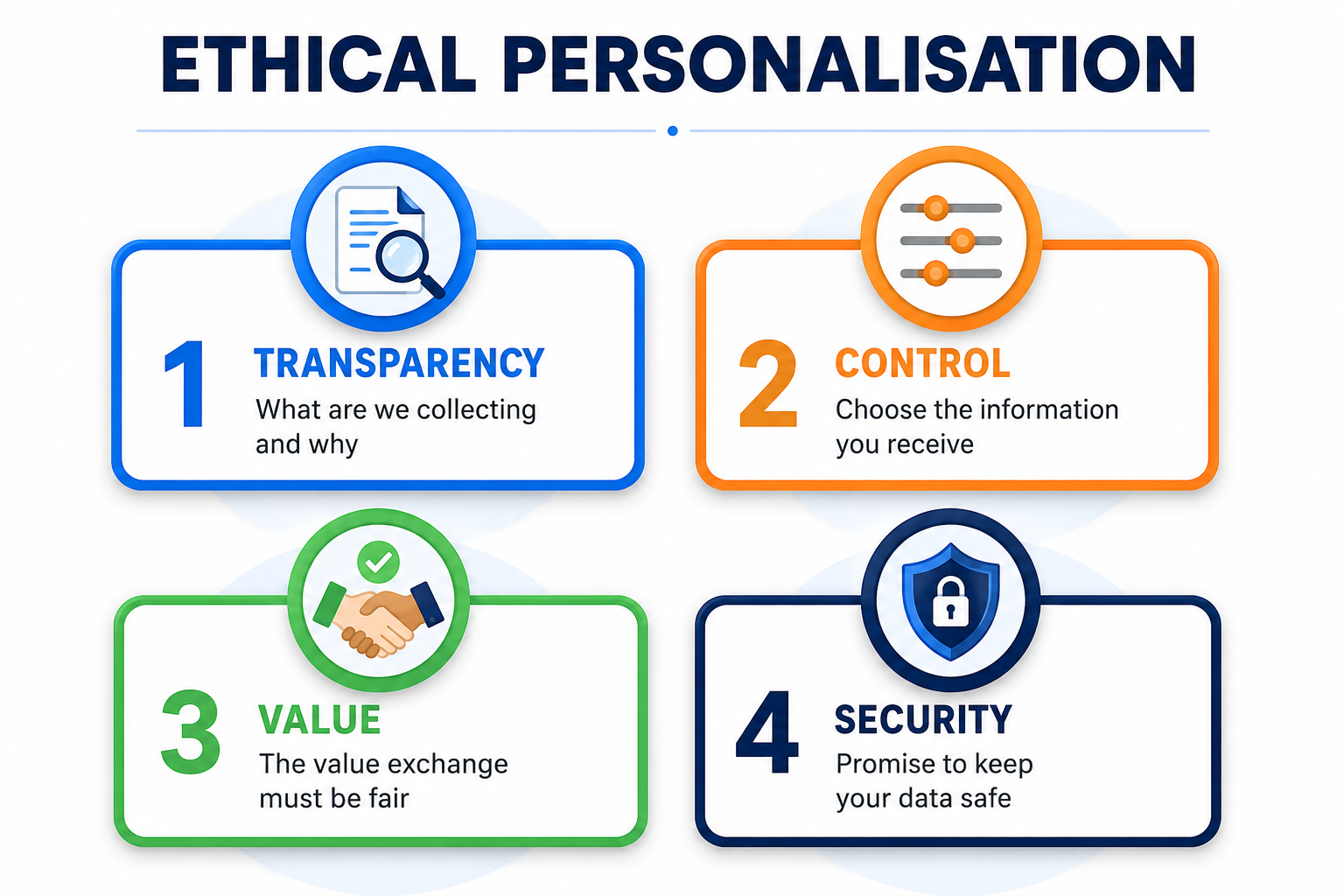
Are customers comfortable with how we use their data?
Are we being clear about what we collect?
Are we giving people control?
Are we creating real value?
Are we protecting the information we have been trusted with?

I believe every business using AI personalisation should start with a simple audit. Look at what data you collect, why you collect it, where it is stored, and whether you really need it.

If you do not need certain data, stop collecting it.

Then look at your communication. Are you explaining personalisation clearly? Are your unsubscribe options easy to find? Do customers have control over frequency and channels? Are your offers genuinely relevant, or are they simply more aggressive?

We also need to train our teams. AI makes execution faster, but speed without judgement creates risk. People inside the business need to understand what ethical personalisation looks like.

Because the goal is not just higher conversion.

The goal is higher conversion without losing trust.

Trust Is the Real Conversion Engine

In the AI age, every brand will have access to powerful personalisation tools.

But tools alone will not create advantage. Trust will.

Customers will reward businesses that use AI to make their lives easier, not the ones that use it to push harder, track deeper, or manipulate faster.

I have explored this topic in more detail in Chapter 3 of my book, Think Digital – Rewired for the AI Age, in the chapter Hyperpersonalisation in the Age of AI. In it, I break down how businesses can use AI to create more relevant, respectful, and trusted customer experiences.

If you are a business owner, marketer, or leader trying to understand how to use AI without losing the human connection, I invite you to read the book and rethink what personalisation should look like in this new era.

Because in the end, the future of personalisation will not belong to the brands that know the most.

It will belong to the brands that are trusted the most.

Frequently Asked Questions

The Trust-to-Utility Matrix is a framework that helps businesses balance personalisation with privacy by evaluating strategies on a scale from helpful to intrusive.

Privacy-by-design ensures that data protection is embedded into AI solutions from the beginning, complying with regulations and enhancing consumer trust.

Businesses can build trust by being transparent about data usage, obtaining user consent, and ensuring privacy is prioritised in their AI systems.

Risks include data breaches and the ethical issues arising from AI making predictions about sensitive user attributes that were not explicitly shared.

AI personalisation can affect trust positively by enhancing user experience, but if overused or mishandled, it may lead to privacy concerns and eroded trust.

0